

Copyright: HGI, stock.adobe.com: chinnarach


In the Press
Events
HGI Cybersec Day
Since 2025, we celebrate an entire day dedicated to cybersecurity research every year.
HGI Cybersec Day combines two elements: in the morning, researchers from HGI, CASA, and MPI-SP have the opportunity to discuss their research in various formats and network with each other. In the afternoon, all HGI members come together in a relaxed atmosphere to celebrate the summer party, exchange ideas away from their everyday work, make new contacts, and enjoy the community of our institute with good food and a summery atmosphere.
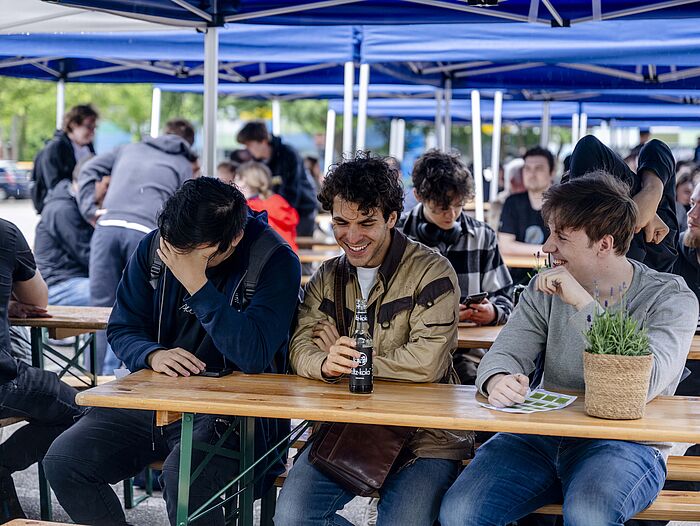
Good spirits despite the rain: HGI Cybersec Day 2025, Copyright: RUB, Maruard
Copyright: CASA
CASA Distinguished Lectures & Invited Talks
To deepen our dialogue with the scientific community, CASA and the HGI host two speaker series: CASA Distinguished Lectures and CASA Invited Talks. Talks typically run for about an hour and are followed by an open discussion with the audience; both series aim to encourage dialogue and open new perspectives in cybersecurity research.
ITS.Connect
We have enjoyed tremendous success over the past ten years in organising the ITS.Connect careers fair, the only Germany-wide event that connects attractive employers with highly qualified IT security graduates. In addition to providing an opportunity for personal exchange amongst companies, public authorities, other organisations and students, the ITS.Connect offers visitors a multifaceted programme of events focused on finding jobs in the industry and career development and planning. The ITS.Connect has grown steadily since its first year in 2008.

Copyright: INDEED Photography, Simon Bierwald
Backgrounds for video conferences
Video conferencing has become part of everyday work, also at our institute. Our HGI backgrounds can be integrated into many video conferencing tools.
Footage
You are welcome to download our logo here if you want to report about the HGI. For further graphical material please contact us at hgi-presse(at)rub.de
Gendersensible Sprache
The HGI attaches great importance to equal opportunites. Outstanding science can only arise in an open culture and a way of thinking that goes beyond the boundaries of gender assignments. This is not only expressed in funding measures and collegial cooperation, but also in the way we communicate.
Within the HGI we have thus agreed on various linguistic techniques to enable gender-sensitive communication.
The Genderstar
To express the diversity of the sexes in language use, we use the so-called "gender star". This asterisk is located between the (german) feminine and masculine gender of the word. It is a symbolic placeholder for diverse and open gender.
Sometimes, however, we use explicit gender attributes, for example when it comes to the concrete fundings of women. We always imply in these cases everyone who consider themselves belonging to that gender, regardless of their biological sex.
In some places, we mark this with a standard formulation among our contributions.
- “In case of using gender-assigning attributes we include all those who consider themselves in this gender regardless of their own biological sex.”
- In other places we use a "consecutive gender star" ( eg in female*researchers), where the asterisk refers to all those considering themselves belonging to that gender.