

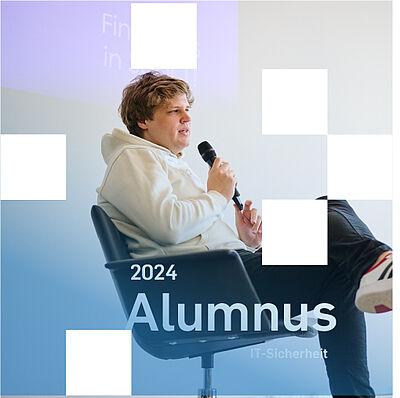
From Bochum to Norway and the U.S., and on to the founding team of a successful cybersecurity startup: The journey of our alumnus Nils Albartus shows what doors a degree in IT security at RUB can open. In his alumni story, he talks about his fascination with hardware reverse engineering, the most important lesson he learned during his studies, and why he finds the work culture at a startup more exciting than that of a large corporation. At the same time, his story encourages others to try new things, seize opportunities, and embark on an adventure—whether it’s a semester abroad, a research project, or starting one’s own business.
Translated with DeepL.com (free version)
How did you get into the ITS program at RUB?
I suppose I was like many others after high school—at first, I had no idea what I wanted to study. So I looked into a lot of options, from International Management to teacher training. In the end, the ITS program won me over—precisely because of its unique position in Germany, Europe, and ultimately around the world. Looking back, I’m incredibly glad I made that decision.
How did you experience your time as a student?
My time as a student was fantastic—we had a great study group where I met some of the people who are now my closest friends. I was never a top student in high school; that changed in college once I figured out how to study effectively. Still, college had its ups and downs—from stressful exam periods to sleepless nights before deadlines. Starting in my third semester, I also held a position as a student assistant in Prof. Paar’s department, which gave me early insights into research—something I can recommend to any student interested in research. Thanks to these insights into the day-to-day work of the department, I knew early on that I wanted to pursue a Ph.D.
You traveled abroad several times during your studies. What experiences do you particularly enjoy looking back on?
I was fortunate enough to be able to complete two study abroad programs. During my fifth semester of my bachelor’s degree, I studied at Høgskolen i Gjøvik in Norway (now part of NTNU). What I found particularly exciting there was that everything was a bit more hands-on—small classes and close contact with the professors. For my master’s thesis, I then went to the University of Massachusetts Amherst. There, too, the collaboration with the professors was fantastic, and I gained yet another, completely different perspective on research. During my time in Amherst, I established many connections with the local research groups, with whom I worked closely over the years during my doctoral studies. Everyone who’s been abroad says it’s a great experience and contributes enormously to personal development. For a long time, I couldn’t quite grasp what exactly that meant—until I experienced it firsthand. I can truly recommend it to anyone who has the opportunity!
Why did you decide to pursue a Ph.D., and what did you research as part of your dissertation?
Through my position as a student assistant, I gained insight early on into a highly specialized but incredibly fascinating topic: hardware reverse engineering—more specifically, FPGA and netlist reverse engineering. The topic captivated me from the very first minute because so much of it takes place behind closed doors—within governments and government-affiliated organizations whose actual capabilities, methods, and technologies have always been somewhat shrouded in secrecy and remain so to this day. Through our research, we sought to shed light on this obscure process and highlight the risks associated with this field.
What are you doing today?
I’m currently the Chief Product Officer at emproof—a now-established startup based in Bochum. I started there in 2022, initially while working on my Ph.D., before joining full-time. Later, I was also welcomed into the founding team—which makes me, in a sense, a late co-founder.
Why did you decide to work at a startup, and what advice would you give to students and graduates who are considering starting their own business?
I wanted to do something that would allow us to advance important, innovative technologies—and to do so in an environment where exceptional talent can grow and thrive. In my experience, that’s not always possible in large corporations. The startup ecosystem is fantastic, and the opportunities at RUB—such as through our startup incubator Cube5 and the StartUpSecure funding program—create a truly unique startup landscape. Of course, we’ve made mistakes over the years—but that’s exactly how you learn. When I look at where we are with emproof today, I can’t help but be amazed—a lot has happened from the initial ideas to the product we have now, and we’re just getting started. To anyone thinking about starting a business, I can only say: Take the plunge and go for it! It’s incredibly fun, but it’s also extremely demanding. With the right team, it’s a fantastic adventure.
What did you learn in college that helps you in your current job?
As a student, I often asked myself: What do I actually need this for? How will this help me later in my career? And sure—you don’t need everything you learn in university. But in my opinion, that’s not what university is about in the first place. What makes the ITS program at RUB so special is the fundamental sense of security it instills in you. You really develop an intuition for how to build systems, protocols, or programs—always with the underlying principle that good security can be built in from the very beginning. You don’t necessarily realize during your studies that you’re acquiring this skill; it just happens naturally. You also learn to work through complex issues on your own—a skill that’s incredibly important in your day-to-day professional life.
General note: In case of using gender-assigning attributes we include all those who consider themselves in this gender regardless of their own biological sex.