

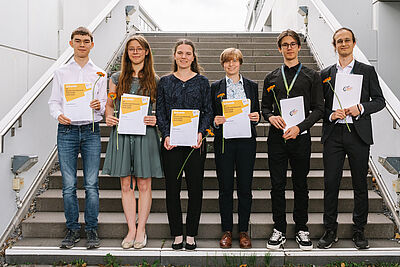
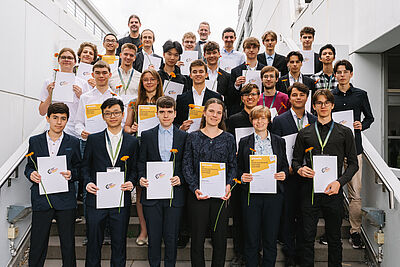
Bochum, September 21, 2026 – Twenty-eight finalists had qualified for the finals after two preliminary rounds, out of a total of 1,626 participants. Over the course of two competition days, they demonstrated their talent: The competition called for not only a deep understanding of computer science problems, but also creativity, good ideas, and the ability to analyze complex problems and develop solutions. The final round was organized by the Faculty of Computer Science at Ruhr University Bochum and the Max Planck Institute for Security and Privacy.
A varied accompanying program also offered the finalists exciting insights into Bochum’s IT ecosystem. The program included, among others, a group dinner at G DATA CyberDefense, the Bochum-based IT security company considered the inventor of commercial antivirus software. For the attending teachers, there was also a Capture-the-Flag workshop led by the RUB CTF team FluxFingers, as well as a workshop on artificial intelligence. During a visit to the ZESS (Zentrum für das Engineering Smarter Produkt-Service-Systeme) research building, the participants also learned about “FetchFly.AI,” a current research project of the Chair of Artificial Intelligence and Formal Methods. In this project, the team is investigating how self-learning drones can take over material supply in production in the future.
“We were very happy to welcome the finalists here. It was impressive to see how they tackled the challenges with such enthusiasm and curiosity. We hope that they’ll take away from Bochum not only many new impressions, but also new connections and an even greater passion for computer science,” said Veelasha Moonsamy, co-organizer of the finals and Vice Dean for Outreach, Transfer, and Internationalization at the Faculty of Computer Science.
Here are the winners
The following talents were awarded as national champions:
-
Daphne Carmesin, 17 years, from Birmingham (King Edward VI Five Ways School, Birmingham)
-
Samuel Dinkelbach, 19, from Baierbrunn (Gymnasium Icking)
-
Anna Färber, 15, from Walldorf (Kurfürst-Friedrich-Gymnasium, Heidelberg)
-
Jan Garloff, 19, from Cologne (Schiller-Gymnasium, Köln)
-
Martha Krebbel, 17, from Aidlingen (Stiftsgymnasium, Sindelfingen)
-
Bennet Schell, 19, from Herborn (Johanneum-Gymnasium, Herborn)
In addition to a money prize, winning the Bundeswettbewerb Informatik comes with admission to the German Academic Scholarship Foundation (Studienstiftung des Deutschen Volkes). The younger finalists also have the chance to qualify for the German team for the International Olympiad in Informatics, which will take place in Potsdam in 2027. “Even the jury couldn’t have answered some of the tasks in the group projects any better, and some of the individual interviews felt more like conversations among colleagues. This was particularly evident among the six national winners and the other prize recipients,” said Maike Buchin, professor of Algorithmics at the RUB’s Faculty of Computer Science and a member of the jury, expressing her enthusiasm for the high level of performance in the final round.
Ingo Wegener Prize
In recognition of her outstanding overall achievement, Daphne Carmesin was also awarded the Ingo Wegener Prize, named after Ingo Wegener, the former chair of the advisory board and a prominent German computer scientist. “For decades, the Bundeswettbewerb Informatik has been identifying and fostering outstanding talents like Daphne Carmesin, thereby making an important contribution to the development of Germany as a hub for computer science,” said Prof. Dr. Markus Bläser of Saarland University, chair of the final-round jury.
The jury selected the following further prize winners:
-
Maxim Akinschin, 15, from Hagen (Fichte-Gymnasium, Hagen)
-
Oskar Behzadpour, 18, from Ortenberg (Wolfgang-Ernst-Gymnasium, Büdingen)
-
Konstantin Meßinger, 16, from Norderstedt (Gymnasium Harksheide, Norderstedt)
-
Bilal Rabie, 17, from Kempten (Allgäu-Gymnasium, Kempten)
-
Paris Skillas, 19, from Hanau (Franziskanergymnasium Kreuzburg, Großkrotzenburg)
-
Oskar Teschner, 19, from Eltville (Gutenbergschule, Wiesbaden)
About Ruhr University Bochum and the Faculty of Computer Science
Unlike any other university in Germany, Ruhr University Bochum embodies change – not only in the region, but also in the individuals who cultivate their talents and forge their paths here. As one of Germany’s largest research universities, it brings together a broad range of disciplines on a single campus. With more than 38,000 students, it offers an interdisciplinary and internationally oriented environment for research, teaching, and knowledge transfer. As the youngest of the 21 RUB faculties, the Faculty of Computer Science—with the Horst Görtz Institute for IT Security and the CASA Cluster of Excellence—has quickly earned an outstanding reputation and ranks among the top institutions in Europe in research and student rankings. More than 35 professors and over 250 staff members conduct research and teach in nearly all subdisciplines of modern computer science.
About the Max Planck Institute for Security and Privacy
Founded in May 2019, the Max Planck Institute for Security and Privacy advances security and privacy research to make a positive impact on society. Combining strong foundational and empirical research, the institute develops new systems, refines existing technologies, and explores emerging challenges. It brings together talented scientists from across the globe in an environment that promotes academic freedom, collaboration, and out-of-the-box thinking, while drawing on perspectives from social science, economics, and law. Located in Bochum, in Germany’s Ruhr Area, the institute is part of one of Europe’s largest academic hubs and an epicenter of innovation in security and privacy.
About the Bundeswettbewerb Informatik
The Bundeswettbewerb Informatik is the longest-running of the Bundesweite Informatikwettbewerbe (nationwide computer science competitions, short: BWINF). These competitions are dedicated to sparking interest in computer science and programming, as well as identifying and nurturing talent. BWINF is supported by the German Informatics Society (GI), the Fraunhofer ICT Group, and the Max Planck Institute for Informatics; it is funded by the Federal Ministry of Education, Family Affairs, Senior Citizens, Women, and Youth. The BWINF are student competitions recommended by the Standing Conference of the Ministers of Education and Cultural Affairs and are held under the patronage of the Federal President. The nationwide computer science competitions make an important contribution to attracting outstanding young talent to computer science and the development of the information and communication society. Many former participants now hold leadership positions in business and academia.
General note: In case of using gender-assigning attributes we include all those who consider themselves in this gender regardless of their own biological sex.
Press contact: Charlotte Schab
Marketing & PR
Fakultät für Informatik
E-Mail: charlotte.schab@rub.de
Tel.: 0234 32-19251