

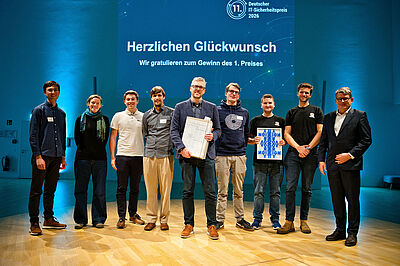
At the eleventh annual German IT Security Award ceremony, the Bochum-based startup Edgeless Systems took first place with its project “Privatemode AI: Cloud-Based AI with Verifiable Confidentiality” and the accompanying prize money of 100,000 EUR. The jury selected the project “zkBridge: Anonymous Credentials on Legacy Devices” for second place, which was awarded 20,000 EUR. Third prize, worth 10,000 EUR, went to “Project Foxhound.” A total of 48 entries were submitted.
The 2026 Award Winners
1st Place – 100,000 EUR
Privatemode AI: Cloud-Based AI with Verifiable Confidentiality
Dr. Felix Schuster, Thomas Tendyck, Dr. Marko Rosenmüller, Moritz Eckert (Edgeless Systems GmbH)
Privatemode AI enables the secure use of generative artificial intelligence, even with confidential data. Thanks to a special, hardware-based security technology called Confidential Computing, inputs and responses remain encrypted both during transmission and while being processed. As a result, neither the cloud operator nor the AI service provider can access the data. Users can also cryptographically verify in advance which software is being used on the servers.
2nd Place – 20,000 EUR
zkBridge: Anonymous Credentials on Legacy Devices
Anja Lehmann, Andrea Flamini, Christian Mouchet, Andrey Sidorenko, Alexandros Zacharakis (Hasso-Plattner-Institut, University of Potsdam), Patrick Amrein, Alexey Lebedenko (Ubique)
The European digital wallet, EUDI-Wallet, which is set to launch in Germany in 2027 under the name “d-you,” will enable digital proof of identity in the future, such as for age verification. zkBridge ensures that only the necessary information is disclosed and that individual pieces of proof cannot be linked to one another. At the same time, the documents are permanently linked to the smartphone and cannot be copied or shared. The solution works with the security chips found in standard smartphones.
3ed Place – 10,000 EUR
Project Foxhound
David Klein (Max Planck Institute for Security and Privacy), Thomas Barber (SAP SE), Martin Johns (TU Braunschweig)
Project Foxhound uncovers security vulnerabilities in websites that conventional scanners often fail to detect. These include, for example, cross-site scripting, which allows attackers to inject malicious code. Using a specially modified version of the Firefox browser, the software tracks how potentially dangerous inputs are processed within a website. This freely available open-source solution has already been used in 15 scientific studies. In these studies, over 500,000 websites were examined, and numerous security vulnerabilities in applications from leading technology companies were uncovered, reported, and fixed. Since 2022, Foxhound has also been used in more than 85,000 security audits of enterprise applications.
Award for Innovation and Practical Applicability
A total of 48 proposals from academia and industry were submitted for the eleventh edition. In a two-stage selection process, an independent jury evaluated the entries based on their level of innovation, practical relevance, and market potential, as well as their contribution to strengthening IT security in Germany. Following a preliminary selection, the nominated projects underwent an in-depth review in a second round of the competition.
Prof. Dr. Michael Waidner, founding director of the National Research Center for Applied Cybersecurity ATHENE and director of the Fraunhofer Institute for Secure Information Technology SIT, chaired the jury. The jury also included Susanne Dehmel (Bitkom), Julia Hermann (Giesecke+Devrient), Prof. Dr. Gregor Leander (Ruhr University Bochum), Claudia Plattner (Federal Office for Information Security), Malte Pollmann, Prof. Dr. Konrad Rieck (Technical University of Berlin), and Christian Stüble (GovTech Germany).
Cybersecurity Innovation Conference: Research, Technology Transfer, and Digital Sovereignty
The awards ceremony was the highlight of the 4th Cybersecurity Innovation Conference organized by the digital industry association Bitkom at the Center for the Engineering of Smart Product-Service Systems (ZESS) in Bochum. The event brought together representatives from academia, business, and politics to discuss current cybersecurity challenges, technological innovations, and Germany’s digital sovereignty.
The awards ceremony was held under the patronage of Federal Minister of the Interior Alexander Dobrindt. Featuring a keynote address by Mona Neubaur, Minister of Economic Affairs, Industry, Climate Protection, and Energy for the State of North Rhine-Westphalia, as well as two panel discussions, the program focused in particular on the role of research and innovation in shaping a secure and sovereign digital future.
Another item on the agenda was the presentation of the nominated concepts. The teams were given the opportunity to showcase their developments and their potential for IT security in short videos.
About the German IT Security Award
The German IT Security Award has been presented every two years by the Horst Görtz Foundation since 2006. It recognizes innovative research and development work that contributes to improving IT security and has the potential to be applied in practice. With total prize money of 130,000 EUR, it is one of the most highly endowed awards for IT security in Germany.
The Horst Görtz Foundation was established in 1996 by Dr.-Ing. E. h. Horst Görtz. It is a nonprofit organization that promotes science and technology in research and teaching, primarily in the field of information security. Its activities include, among other things, supporting early-career researchers, funding endowed professorships, and organizing professional events.
The 2026 awards ceremony was organized by the Horst Görtz Institute for IT Security at Ruhr University Bochum on behalf of the Horst Görtz Foundation, in cooperation with the digital industry association Bitkom e. V. and the National Research Center for Applied Cybersecurity ATHENE in Darmstadt.
Press Contact
Thomas Würstlein
Horst Görtz Institute for IT Security
Universitätsstraße 150, 44780 Bochum
+49 234 32-29822 thomas.wuerstlein(at)rub.de
General note: In case of using gender-assigning attributes we include all those who consider themselves in this gender regardless of their own biological sex.