

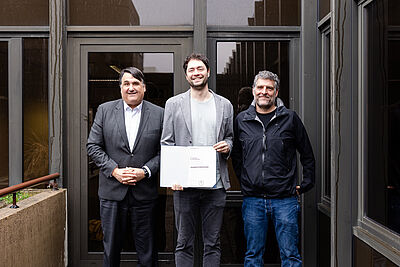
As of March 1, 2026, Jonas Haferkamp has joined the Faculty of Computer Science at Ruhr University Bochum as the holder of the Horst Görtz Foundation Endowed Professorship in Quantum Computing. The professorship was formally conferred in early February 2026 by Rector Martin Paul and Dean Gregor Leander and is supported by funding from the Horst Görtz Foundation totaling €1.15 million.
“We are very grateful to the Horst Görtz Foundation for its commitment and support,” said Rector Martin Paul during the ceremony. “This endowed professorship marks an important step in further strengthening cutting-edge research in quantum computing at our university and in promoting interdisciplinary collaboration.”
Exceptional Computational Potential
Quantum physics studies the behavior of nature’s most fundamental building blocks. In his research, Haferkamp will investigate both the theoretical foundations and the technological applications of quantum physics. Due to their physical properties, quantum technologies could enable extraordinary computational and information-processing capabilities.
At the same time, the quantum world remains highly complex, and many of its phenomena are not yet fully understood. Unlike classical physics, quantum mechanics describes systems whose states cannot always be predicted deterministically but only probabilistically.
For many people, this makes quantum physics difficult to grasp. Haferkamp understands this challenge: “As humans, we have an intuition for how the world around us works. We usually perceive things as clearly defined—something is either here or there. Quantum physics, however, often defies this logic.” Quantum systems, by contrast, can exist in so-called superposition states. In simplified terms, this means that they do not occupy a single definite state but can exist in several possible states simultaneously. Only when a measurement is performed does one of these states become observable, with a probability determined by the quantum system.
Randomness in Quantum Systems
A key contribution of Haferkamp’s previous research has been the study of randomness properties in quantum systems. Working with an international team of researchers, he contributed to theoretical results showing that certain random quantum states can be generated more efficiently than previously thought.
These findings are important for the development of future quantum technologies, as the controlled generation of randomness can play a crucial role in the operation of quantum computers. Looking ahead, the trained physicist aims to bring these insights more strongly into the field of computing. His research follows an interdisciplinary approach. On the one hand, he investigates how concepts from information theory—particularly in cryptography—can be analyzed using methods from quantum physics, for example in assessing the security of new encryption schemes designed for quantum computers. On the other hand, he is also interested in the reverse perspective: whether methods from information technology, such as cryptography, might provide broader insights into fundamental questions in physics.
With many renowned researchers in the field based in Bochum, Haferkamp is optimistic about interdisciplinary collaboration. “I’m very much looking forward to exchanging ideas with colleagues in cryptography as well as with researchers from other areas of computer security,” he said.
About Jonas Haferkamp
Jonas Haferkamp studied physics and mathematics at Leibniz University Hannover and the University of Hamburg. In 2023, he earned his Ph.D. from Freie Universität Berlin with a dissertation on complexity and randomness in quantum information theory. He subsequently worked as a postdoctoral researcher and HQI Fellow at Harvard University in the United States and later served as a junior professor at Saarland University.