

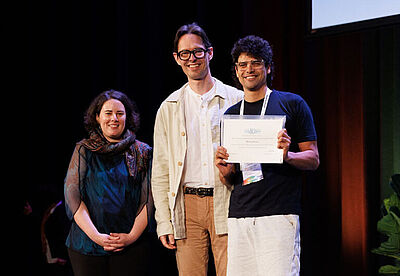
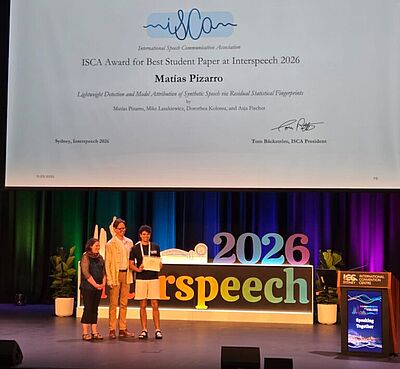
Each year, the International Speech Communication Association (ISCA) recognizes outstanding student papers at its Interspeech Conference. In 2026, fourteen papers were nominated and the three winners included “Lightweight Detection and Model Attribution of Synthetic Speech via Residual Statistical Fingerprints” by Matías Pizarro, Mike Laszkiewicz, Dorothea Kolossa, and Asja Fischer. In this work, the researchers developed a lightweight, cross-language and cross-system approach to detect not only whether an audio is AI-generated, but also by which specific model. The potential applications of such a method are manifold. For instance, the insights gained through Residual Statistical Fingerprints could help combating deepfakes, disinformation, and fraud.
The research presented in the paper is also part of Matías’ dissertation, titled “Emerging Threats in Speech Systems: From Combating Adversarial Examples to Detecting Synthetic Speech”,which he successfully defended in September 2026. Under the supervision of Asja Fischer (RUB) and Dorothea Kolossa (TU Berlin), he examined various challenges and threats arising from the increasing use of autonomous voice agents. The aim is to develop practical, lightweight, and training-free mechanisms to detect manipulations of automatic speech recognition systems and attributing synthetic speech to the generative speech model that generated it. This could help identify and mitigate potential threats, thereby enhancing the trustworthiness of modern communication systems.
The ISCA Award Committee partly based its decision on a video in which Matías presents the paper and its findings (recorded and edited by Pina Merkert).
General note: In case of using gender-assigning attributes we include all those who consider themselves in this gender regardless of their own biological sex.