

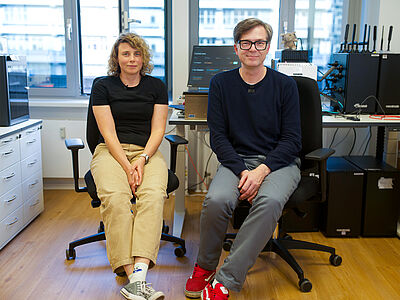
Does encrypted equal secure? Not necessarily. Whether you’re chatting with friends or sending a quick message to a coworker, anyone who sends an encrypted message assumes it will reach the receiver safely. During his visit to Ruhr University Bochum, cybersecurity researcher Prof. Katharina Kohls explains to host Ralph Caspers that even encrypted messages can be manipulated and why research on this topic is happening in the Ruhr area.
Professor Katharina Kohls is Head of the System Security Chair at the Faculty of Computer Science at Ruhr University Bochum and is also a member of the Cluster of Excellence CASA. Her research focuses on the security and data protection of mobile networks, which play a central role in everyday wireless communication.
As part of the Regionalverband Ruhr (RVR)’s social media campaign “The Ruhr Area. Here, everything stays different,” TV host and author Ralph Caspers – known for the educational show “Wissen macht Ah!” – visited the researcher in her lab and got a demonstration of an attack scenario: Despite secure encryption, the content of a message can still be manipulated. While encryption ensures that unauthorized parties cannot read the content of a message, potential attackers are still able to manipulate the code without having to decrypt the message itself. Without an appropriate security check, the manipulation goes unnoticed and an altered message appears on the recipient’s device. To prevent this from happening in reality, there are security researchers like Katharina Kohls who constantly analyze security vulnerabilities and develop solutions.
But why is cybersecurity approached differently right here in the heart of the Ruhr area? “Because there are a lot of really smart people here who come together in this place,” says Katharina Kohls. After spending several years abroad, she herself returned to Ruhr University Bochum to conduct research.
The video was posted on November 19 on the RVR's channels:
Instagram:@das.ruhrgebiet
TikTok:@das.ruhrgebiet
General note: In case of using gender-assigning attributes we include all those who consider themselves in this gender regardless of their own biological sex.