

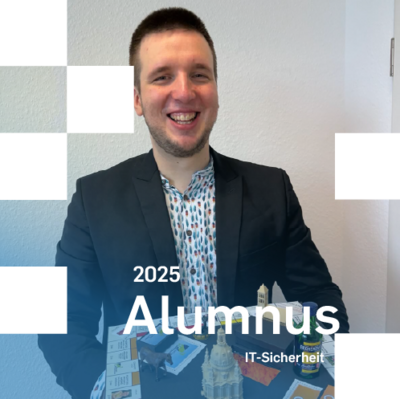
Georg Land took advantage of the flexibility and freedom offered by his studies to explore different fields, gain new perspectives, and start a family at the same time. His enthusiasm for the interplay between theory and practice has been a constant throughout his academic career, from his bachelor’s degree to his doctorate. In his alumni story, he recounts his intensive experience during his bachelor’s and master’s programs in IT Security and provides insights into the focus of his doctoral research. Today, he works as a Security Research Engineer and Scientist at Intel.
You recently completed your doctorate. But let’s start at the beginning: How did you end up studying at the RUB?
My brother started studying ITS a few years before I did, and whenever I visited him, I found what he was doing there really fascinating. In fact, my initial interest in technology and computers came from him.
How did you experience your time as a student?
My time in university was filled with freedom and curiosity, engaging with different perspectives and knowledge, and experimenting with ideas that, in hindsight, didn’t really make much sense. Looking back, as the child of working-class parents (and the second in the family after my brother to go to university), I unfortunately didn’t have the courage to study abroad, which I regret a little today.
Later on, I took full advantage of and enjoyed the flexibility that university life offered: shortly after finishing my bachelor’s degree, our first child was born; shortly before starting my master’s thesis, our second child arrived. At the same time, I worked part-time at Kasper & Oswald (a startup in Bochum) for a total of just under five years, where I was entrusted with a great deal of responsibility. Unfortunately, there was also a death in the family during that time. It was a very intense period.
Academically, my interests have shifted quite a bit since I started college: Like many freshmen back then, I approached my studies with a rather one-dimensional view (hacking! cracking passwords!). Relatively soon, however, I developed a passion for bridging the gap between theory and practice: understanding one side, applying that knowledge to the other, and providing feedback in the process. The environment, in which many truly top-notch researchers from various subfields constantly challenged us, naturally helped a great deal.
How did you manage to balance family life and your studies?
Balancing our studies with raising young children worked out for us mainly thanks to very careful planning of our time and responsibilities, and my wife’s tremendous dedication. At the same time, it was important to us to share the caregiving responsibilities as evenly as possible. For me, this meant studying largely on my own using online materials and attending only the truly essential in-person classes. In a way, balancing family and studies forced me to work and study efficiently.
Otherwise, I often just brought my kids to the university with me, which I think should become even more common than it already is. And as difficult as the pandemic was, it did pave the way for doctoral students to work from home if their child gets sick. I took advantage of that regularly after my wife returned to work.
Financially, BAföG—with its childcare supplement and higher income exemption—along with child benefit and the child supplement (which, unfortunately, very few people know about!)—was a huge help. Later, during my doctoral studies, we initially received housing assistance despite having a relatively good income; here, too, I can only recommend that all doctoral students with children check whether they’re eligible.
What did you do after you finished your master’s degree?
First, we took a short three-month break during which we traveled a bit. After that, I continued working full-time at Kasper & Oswald to bridge the gap until my PhD program began. In October 2019, I began my PhD at the Security Engineering Chair under Tim Güneysu. Of course, that didn’t go exactly according to plan either—we had our third child in early 2020. So, after my parental leave, I was able to make a “great” start to working from home during the lockdown.
What did you research within the scope of your doctoral studies?
The general focus was on questions regarding the implementation of post-quantum cryptography—that is, cryptographic methods that are secure even against quantum computers. Here, too, I was given a great deal of freedom, which allowed me to ultimately conduct research and publish in many different subfields, such as
- Security of these new methods against side-channel attacks (roughly: measuring power consumption to deduce the key)
- The efficiency of new software and hardware algorithms (including the efficient design of new algorithms)
- Enhance the practicality of methods that achieve advanced security goals, such as zero-knowledge proofs or anonymous credentials
What do you do for a living these days?
Today I work at Intel, where I’m essentially building on the fascination that first gripped me during my studies: bridging the gap between theory and practice. Specifically, I’m responsible for ensuring that cryptographic methods are embedded efficiently and securely into our products. Currently, of course, the focus is on the important transition to post-quantum cryptography. Fortunately, this also means that my work remains closely tied to research, while at the same time I have to find customized solutions for many interesting and very diverse use cases. So I deal with very practical issues.
What fascinates you most about research?
I find it fascinating to combine knowledge from different fields and come up with new ideas in the process. And to realize along the way that you’re often wrong, and then to learn from that and make improvements.
General note: In case of using gender-assigning attributes we include all those who consider themselves in this gender regardless of their own biological sex.